
Why you should eat more sprouts
Nutrient-Dense and Lightning-Fast: The Case for Eating More Sprouts

Have you heard of sprouts?
These tiny powerhouses are one of nature's most remarkable foods. Small, quick-growing, and incredibly nutritious, sprouts transform from dormant seeds to nutrient-rich greens in just days.
Even better, sprouts are one of the most resource-efficient foods you can grow at home, using barely any water, no soil, and minimal space.
By eating more sprouts, you can enjoy fresh, living nutrition year-round while making a choice that's gentle on the planet.
Let's explore why adding sprouts to your diet can transform both your health and your relationship with food.

What are Sprouts?
Sprouts are seeds at the very beginning of their growth, harvested just 3-4 days after germination begins.
Unlike microgreens (which grow longer until leaves develop), sprouts are eaten at the earliest stage: when the seed has just cracked open, released a root, and begun to unfold. You eat the whole thing: seed, root, and tiny shoot.
Common sprouting seeds include lentils, mung beans, chickpeas, peas, radish, and alfalfa. Each variety brings its own flavor, from mild and nutty to peppery and fresh.
Despite being harvested so young, sprouts pack an extraordinary nutritional punch. During germination, something remarkable happens inside the seed: dormant nutrients wake up, anti-nutrients break down, and new vitamins are created that weren't there before.
Sprouts go from seed to plate in less than a week, need almost no resources to grow, and can be cultivated year-round in any kitchen.

Why Sprouts are good for you
1. Germination Unlocks Hidden Nutrition: When a seed sprouts, its metabolism activates. Enzymes break down stored nutrients into simpler, more bioavailable forms. Research shows that mineral bioavailability increases dramatically during sprouting. For example, iron absorption improves from 18% to 37% in sprouted wheat, and zinc from 15% to 27% (source). Your body can actually use these nutrients more effectively than from dry seeds.
2. Vitamins Appear Where There Were None: Sprouting creates vitamins that simply don't exist in dormant seeds. Vitamin C, for instance, goes from zero to 24mg per 100g in sprouted buckwheat and quinoa after just 2-3 days (source). B vitamins increase significantly, supporting energy metabolism and nervous system function.
3. Anti-Nutrients Break Down: Seeds naturally contain compounds like phytic acid that bind to minerals, preventing absorption. During sprouting, the enzyme phytase activates and breaks down these anti-nutrients, freeing minerals like calcium, iron, and zinc for your body to use (source).

4. Proteins Become More Digestible: Sprouting breaks complex proteins down into amino acids, the building blocks your body needs. This makes sprouts easier to digest than dry seeds or beans, and gentler on your digestive system.
5. Packed with Antioxidants: Sprouts are rich in polyphenols, flavonoids, and other antioxidant compounds that protect your cells from damage. These concentrations increase during germination as the seed prepares to become a plant (source).
6. Living Food at Peak Freshness: Sprouts are living plants when you eat them. Unlike produce that loses nutrients during transport and storage, homegrown sprouts are harvested seconds before eating, preserving their nutritional value at its absolute peak.

Why Sprouts are good for the planet
1. Incredibly Water-Efficient: Sprouts use about 95% less water than conventionally grown vegetables. A handful of seeds and a few rinses produce generous amounts of food. No irrigation, no rain dependency, just a small amount of water twice a day.
2. No Soil Needed: Growing sprouts requires no farmland, no soil depletion, and no erosion. They grow in clean water, leaving the earth untouched.
3. Zero Food Miles: When you grow sprouts at home, there's no transportation, no refrigeration, no packaging. Your "food miles" are literally from kitchen counter to plate: the ultimate in local eating.

4. Year-Round Production: Sprouts don't depend on seasons, weather, or climate. They grow just as well in winter as in summer, providing fresh greens when outdoor growing is impossible.
5. Minimal Food Waste: Because sprouts grow so quickly and in small batches, you can harvest exactly what you need, when you need it. No wilted greens in the back of the fridge.
6. No Pesticides Required: The short growing cycle and indoor environment mean sprouts need no chemical interventions. It's pure, clean food from start to finish.

The Remarkable Science of Sprouting
What's happening inside that tiny seed when water activates it is genuinely remarkable.
For months or even years, seeds remain dormant, waiting for the right conditions to grow. When you soak them, water triggers a cascade of biological activity. Enzymes that were inactive suddenly spring to life. Stored starches convert to simple sugars. Proteins break down into amino acids. Fats become fatty acids.
The seed is essentially pre-digesting itself, making nutrients available for the emerging plant.
But here's the fascinating part: we can harvest and eat the sprout at this exact moment, benefiting from all that nutritional transformation.

Research from institutions like Johns Hopkins University has shown that certain sprouts contain extraordinarily high levels of beneficial compounds.
Broccoli sprouts, for example, have 20-50 times more sulforaphane than mature broccoli (source). This compound activates the body's natural detoxification pathways, helping eliminate environmental toxins.
But you don't need to get scientific about it to benefit. Simply eating a variety of fresh sprouts regularly gives you access to nutrients in their most bioavailable, easily absorbed form.
Sprouts: The Ultimate Flavor & Texture Booster
-
Sprouts add fresh crunch and flavor to virtually any meal.
They brighten salads with texture and mild flavor. They add satisfying crunch to sandwiches and wraps. They're perfect on top of soups, stirred into grain bowls, or layered onto avocado toast. -
The beauty of sprouts is their versatility. Mild varieties like mung bean and lentil sprouts work anywhere. Peppery radish or mustard sprouts add a kick to rich foods. Each variety brings something different to the table.
Harvest them fresh, rinse them clean, and enjoy them immediately for maximum flavor and nutrition.
Homegrown Fresh Food in Just Days
To sum it all up: Sprouts are phenomenally nutritious, incredibly efficient, and remarkably easy to grow.
Growing sprouts at home requires almost nothing: just seeds, water, and a few minutes twice a day. No special equipment, no green thumb, no learning curve.
With the Patina Germina sprouting set, the process becomes completely intuitive.
Soak your seeds overnight. Rinse them twice a day. Watch them transform. In 3-4 days, you're harvesting fresh, living nutrition.
It's the simplest form of growing your own food, and one of the most rewarding.
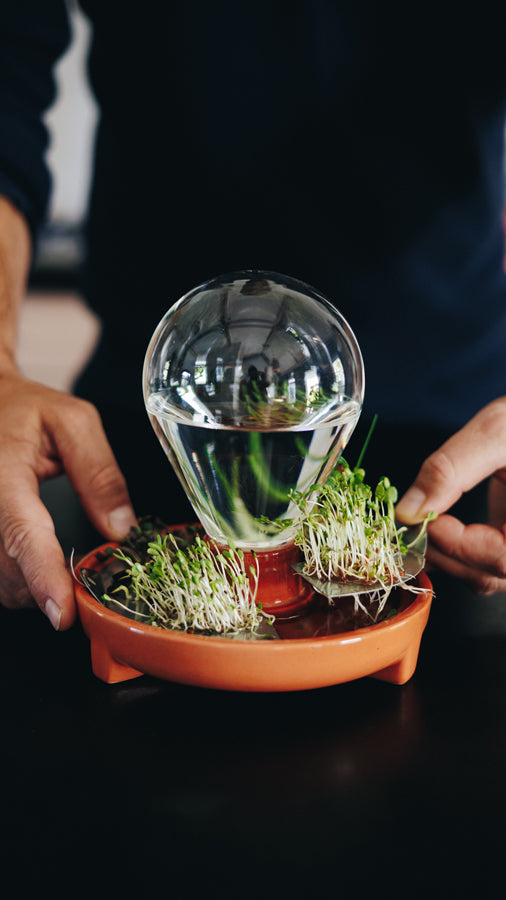
Different Stages, Different Benefits
Want to take your growing further? Microgreens are sprouts that have been allowed to grow a few more days, developing true leaves and even more concentrated flavors. While sprouts are ready in 3-4 days, microgreens take 7-10 days and develop different nutritional profiles as photosynthesis begins.
Both are valuable. Both are nutritious. The choice is simply about timing:
Sprouts = fastest nutrition, simplest process, 3-4 days
Microgreens = more developed flavor, higher vitamin concentration, 7-10 days
With Patella Crescenda, you can grow microgreens on water and harvest them with roots intact—extending the growing process for different textures and tastes.
Read more about why microgreens are nutritional powerhouses →

Start sprouting Today
Growing sprouts at home won't solve everything. But it will change how you think about food.
When you grow your own sprouts, even just a small bowl on your kitchen counter, you're taking a real step toward self-reliance. You're eating food at its freshest possible moment. You're using minimal resources. And you're reconnecting with something fundamental: the simple act of growing what you eat.
Sprouts are ready when you are. Fresh, crunchy, and full of life.
Let's get the sprouting started!
Got Questions About Sprouting?
We've answered everything from "which seeds work best?" to "what if I forget to rinse?" in our comprehensive Sprouting FAQ.
Ready to start growing your own fresh sprouts?
Scientific Research & References
-
General Sprout Nutrition & Germination
1. Xiao, Z., et al. (2021) - "The Use of Sprouts to Improve the Nutritional Value of Food Products" PubMed
Key findings: Sprouts rich in glucosinolates, phenolics, isoflavones. High vitamins/minerals, reduced anti-nutritional factors.2. Singh, A. K., et al. (2021) - "Nutritional and end-use perspectives of sprouted grains: A comprehensive review" PMC (PubMed Central)
Key findings: Mineral bio-accessibility increases dramatically (Fe 18% → 37%, Zn 15% → 27% in wheat).3. Montemurro, M., et al. (2023) - "Sprouts as probiotic carriers: Opportunities and challenges" PMC (PubMed Central)
Key findings: Germination breaks down phytates via phytase enzyme. Increases vitamin C and B complex significantly.4. Plaza, L., et al. (2021) - "An overview of the nutritional properties of sprouts and their application in food products" ScienceDirect
Key findings: Sprouting breaks down macronutrients, increases amino acids. Decreases anti-nutritional components, increases polyphenols and vitamin C.5. Vale, A. P., et al. (2024) - "Unlocking the functional potential of sprouts: A comprehensive review" ScienceDirect
Key findings: Germination improves digestibility of proteins and starch, bioaccessibility of minerals and phenolic compounds. -
Vitamin & Mineral Bioavailability
6. Babylon Garden (2023) - "About vitamins, minerals and fibre in sprouts and microplants" Babylon Garden Blog
Key findings: Buckwheat/quinoa develop 24mg vitamin C per 100g after 2-3 days (from zero). Phytic acid releases phosphorus during germination.7. Mleczek, M., et al. (2021) - "Determination of Essential Minerals and Trace Elements in Edible Sprouts" PMC (PubMed Central)
Key findings: Different sprouts excel in different minerals. Beetroot sprouts highest in magnesium (836mg/100g DM). Onion sprouts richest in manganese and calcium.About Our Approach to Scientific Information
House of Thol values scientific accuracy and transparency. We cite research to help you understand the biological processes behind sprouting, but we do not make medical claims. Sprouts are food, not medicine.
For questions about how sprouts might fit into your specific dietary needs, please consult with a healthcare professional or registered dietitian.
Last updated: February 2026